Blog
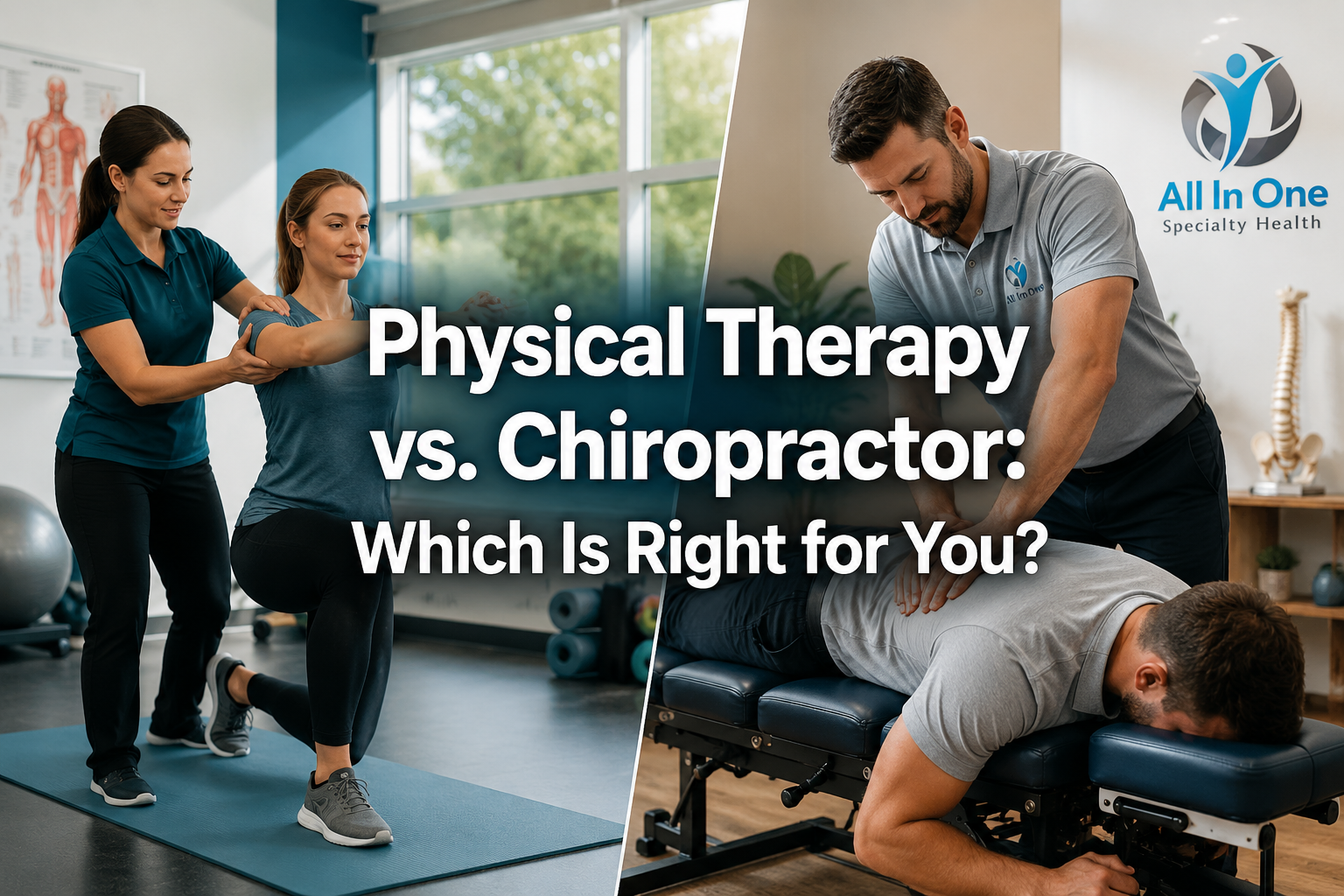
Physical Therapy vs. Chiropractor: Which Is Right for You?
Physical therapists and chiropractors both treat musculoskeletal pain, but they work differently.
June 2, 2026
Clinically reviewed by Patricia Freire, PT (Florida license PT13065), All In One Specialty Health, Miami Gardens. Medical disclaimer
Last updated: June 3, 2026
Quick Answer
Physical therapists and chiropractors both treat musculoskeletal pain, but they work differently. Physical therapy (PT) focuses on long-term recovery through guided exercise, manual therapy, and neuromuscular re-education to restore strength and function, while chiropractic care centers on spinal adjustments to relieve joint and alignment-related pain. For most cases of injury recovery, post-surgical rehab, chronic pain, and sports injuries, evidence-based physical therapy offers the most complete path to lasting results.
Key Takeaways
- Physical therapists are licensed clinicians who treat the whole body through movement, strength training, and hands-on care.
- Chiropractors specialize in spinal manipulation and joint alignment, typically for back and neck complaints.
- PT is usually the better fit for post-surgical recovery, sports injuries, chronic pain, and mobility loss.
- Most insurance plans, including Medicare and PIP, cover physical therapy when medically necessary.
- Florida allows direct access to PT — you generally don't need a referral to start.
- Chiropractic adjustments carry a small but real risk profile, especially for the cervical spine.
- A personalized treatment plan from a licensed PT often prevents repeat injuries and avoids surgery.
- At All In One Specialty Health in Miami Gardens, bilingual care and same-week appointments make starting easier.
What's the Difference Between a Physical Therapist and a Chiropractor?
A physical therapist (PT) is a licensed healthcare professional with a Doctor of Physical Therapy (DPT) degree, trained to evaluate movement, prescribe exercise, and use manual techniques to restore function across the entire body. A chiropractor (DC) holds a Doctor of Chiropractic degree and focuses primarily on spinal manipulation and joint alignment to address pain believed to stem from misalignments.
The core difference comes down to philosophy and tools:
- PTs treat the cause through movement retraining, strengthening, mobility work, neuromuscular re-education, and patient education. Goal: lasting independence.
- Chiropractors treat symptoms through manual adjustments ("cracks"), often delivered in short, repeat visits. Goal: realign and relieve.
Both providers are licensed in Florida, but their scope, training, and approach diverge significantly. For a deeper look at how PTs treat movement-based problems, see our overview of evidence-based physical therapy.
A chiropractor adjusts. A physical therapist rebuilds.
Which Treatment Works Better for Back Pain?
For most cases of back pain, physical therapy delivers more durable relief because it targets the underlying weakness, stiffness, and movement patterns driving the pain. Chiropractic adjustments may offer short-term comfort, but they don't strengthen the muscles that protect your spine.
Research generally supports active care — meaning exercise-based treatment — over passive manipulation alone for chronic low back pain. A PT will assess your posture, core strength, hip mobility, and daily habits, then build a personalized treatment plan to address each factor.
Choose PT if:
- Your back pain has lasted more than a few weeks
- You've had a bulging or herniated disc
- You want to avoid surgery
- You need to return to lifting, sports, or work
Chiropractic may help short-term if:
- You have sudden joint stiffness with no neurological symptoms
- You've already ruled out disc or nerve involvement
For chronic cases, our low back pain physical therapy program addresses the full picture.
How Much Does Physical Therapy Cost Compared to Chiropractic Care?
Out-of-pocket physical therapy visits in Miami-Dade typically range from $75 to $200 per session, while chiropractic visits often run $40 to $120 per adjustment. However, chiropractors usually require many more visits over time, so total costs often even out — or favor PT for long-term value.
| Factor | Physical Therapy | Chiropractic |
|---|---|---|
| Average visit cost (cash) | $75–$200 | $40–$120 |
| Typical course of care | 6–12 visits | 12–40+ visits |
| Insurance coverage | Broad (PPO, HMO, Medicare, PIP) | Variable; some plans limited |
| Home program included | Yes, standard | Less common |
| Long-term value | High (teaches self-management) | Often requires maintenance visits |
For specifics on PT pricing in our area, see our orthopedic PT cost guide for Miami Gardens.
Can a Physical Therapist Help Me Recover From a Sports Injury?
Yes. Physical therapists are the primary specialists for sports injury rehabilitation, guiding athletes from acute injury through return-to-play with measurable progress. Whether you tore an ACL, sprained an ankle, or strained a hamstring, a PT designs a stage-by-stage program that restores strength, balance, and sport-specific movement.
Common sports injuries treated with PT:
- ACL tears and reconstruction rehab
- Ankle sprains
- Rotator cuff injuries in athletes
- IT band syndrome
- Groin pulls
Chiropractors don't typically manage post-operative rehab, return-to-sport testing, or progressive loading — areas where PTs lead. If you're an athlete in Miami Gardens, Miami Lakes, or Hialeah, our sports injury rehabilitation services cover evaluation through full recovery.
What Conditions Do Chiropractors Treat That PT Can't?
Honestly, very few. Chiropractors are well-known for spinal manipulation, but PTs are also trained in joint mobilization and high-velocity manipulation as part of manual therapy. The bigger picture: chiropractors generally don't manage post-surgical rehab, neurological rehab, vestibular disorders, or complex orthopedic recovery — all areas where PT is the standard of care.
Where a chiropractor may be the right first stop:
- Acute, uncomplicated joint stiffness or "stuck" feeling without nerve symptoms
- Patients who specifically want manipulation as their primary intervention
For nearly everything else — post-op recovery, chronic pain, balance loss, sports injuries, neuromuscular conditions — a licensed physical therapist is the broader, more flexible choice.
Is Physical Therapy Covered by My Insurance?
Most major insurance plans cover medically necessary physical therapy, including PPO, HMO, Medicare, Florida PIP (auto insurance), and workers' compensation. Coverage details — copays, visit limits, deductibles — vary by plan, so it's smart to verify benefits before starting. At All In One Specialty Health we accept the plans on our insurance page; we do not accept Medicaid.
What's typically covered:
- Evaluation and treatment when prescribed or medically necessary
- Post-surgical rehabilitation
- Injury recovery from accidents (including PIP for Florida auto crashes)
- Chronic condition management when documented
Florida is a direct access state, so most patients can begin PT without a doctor's referral — though some insurers still require one for billing. Our team verifies your benefits upfront. Learn more about referral rules for PT in Florida.
Disclaimer: Coverage varies by plan and individual policy. This is general education, not insurance advice.
How Long Will I Need Treatment With a PT vs. Chiropractor?
A typical PT course runs 4 to 12 weeks with 1–3 visits per week, after which most patients graduate to a home program. Chiropractic care often becomes an ongoing relationship with regular maintenance visits, sometimes indefinitely.
PT timelines by condition:
- Minor sprains/strains: 2–4 weeks
- Post-surgical recovery (knee, shoulder, spine): 8–16 weeks
- Chronic pain: 6–12 weeks
- ACL reconstruction: 6–9 months (full return-to-sport)
Most PT patients reach discharge once they hit their functional goals. For a fuller breakdown, see how many physical therapy sessions you'll likely need.
Are Chiropractors Good for Neck and Spine Alignment?
Chiropractors are trained in cervical spine manipulation, and many patients report short-term relief from neck adjustments. That said, the cervical spine is the highest-risk area for manipulation, and PT-led manual therapy plus targeted exercise often delivers comparable relief with a safer profile.
For neck pain, a physical therapist will:
- Assess posture, deep neck flexor strength, and shoulder blade control
- Use gentle joint mobilization (lower-velocity than chiropractic)
- Prescribe strengthening for the muscles that support your neck
- Address contributing factors like desk setup and sleep position
If your neck pain comes with headaches, dizziness, or arm symptoms, PT's broader scope is usually the better fit.
What Should I Look for When Choosing Between PT and Chiropractic Care?
Choose based on your condition, your goals, and the credentials of the provider. The right clinic listens, evaluates thoroughly, and explains your plan in plain language — in English or Spanish.
Checklist for picking a provider:
- Credentials: DPT for physical therapists, DC for chiropractors. Both should be Florida-licensed.
- Evaluation depth: Look for a 45–60 minute first visit with a full functional assessment.
- Treatment variety: A good provider uses more than one tool (manual therapy, exercise, education).
- Clear goals: You should leave the first visit knowing your plan and timeline.
- Insurance & cost transparency: No surprises on the bill.
- Bilingual care: Critical in Miami-Dade — patients heal faster when they understand instructions fully.
- Local accessibility: Same-week scheduling matters when you're in pain.
If you're weighing your options, our guide on what to expect at your first PT visit walks through the process.
Can Physical Therapy Prevent Future Injuries?
Yes — injury prevention is one of PT's strongest contributions. Physical therapists use functional movement screening, strength testing, and individualized exercise to address the weaknesses and imbalances that cause repeat injuries.
PT prevents future injuries by:
- Building strength in the muscles that protect your joints
- Improving balance and reaction time
- Correcting movement patterns from past compensations
- Teaching warm-up, recovery, and load-management habits
For athletes, functional movement screening identifies risk before injury happens. For older adults, balance training reduces fall risk dramatically. Chiropractic care, by contrast, doesn't typically include progressive strengthening or sport-specific drills.
Risks and Side Effects of Chiropractic Adjustments
Most chiropractic adjustments are safe, but they carry real risks worth knowing — especially in the neck. Common side effects include soreness, headache, and temporary stiffness. Rare but serious risks include rib fracture, worsened disc herniation, and in cervical manipulation, vertebral artery injury that can lead to stroke.
You should avoid or delay manipulation if you have:
- Osteoporosis or low bone density
- Active inflammatory arthritis
- Recent spinal surgery
- A history of stroke or vascular disease
- Neurological symptoms (numbness, weakness, loss of bladder control)
Physical therapy uses gentler joint mobilization and progressive loading, which carry a much lower risk profile while still addressing the underlying problem.
Which Treatment Is Best for Chronic Pain Management?
For chronic pain — meaning pain lasting longer than three months — physical therapy is the recommended first-line approach. Chronic pain involves both tissue and nervous system changes, and PT addresses both through movement, education, graded exposure, and self-management strategies.
A modern chronic pain PT plan includes:
- Pain science education so you understand what's actually happening
- Graded exposure to rebuild confidence in movement
- Strength and conditioning to restore deconditioned tissue
- Lifestyle and sleep coaching
Patients with chronic low back pain and fibromyalgia often see meaningful improvement when chiropractic adjustments alone haven't helped. Chronic pain rarely responds to passive treatment alone.
FAQ
Do I need a referral to start physical therapy in Florida?
No. Florida is a direct access state, so you can typically begin PT without a doctor's referral. Some insurance plans may still require one for coverage.
Can I see a PT and a chiropractor at the same time?
Yes, but coordinate care so treatments don't conflict. Tell each provider what the other is doing.
Is physical therapy painful?
PT can cause mild soreness, but it shouldn't be sharply painful. Therapists adjust intensity to your tolerance. Read more on whether PT should hurt.
Does Medicare cover physical therapy?
Yes. Medicare Part B covers outpatient PT when medically necessary, with a coinsurance after the deductible. Coverage details depend on your specific plan.
How soon should I start PT after an injury?
Generally within 1–2 weeks for soft tissue injuries, sooner for post-surgical cases. Earlier care typically means faster recovery. See when to start PT after injury.
Are PTs at All In One Specialty Health bilingual?
Yes. Our team provides care in English and Spanish across Miami Gardens, Miami Lakes, and Hialeah.
What should I wear to my first PT visit?
Comfortable, loose clothing and athletic shoes. Bring access to the body part being treated.
Can PT really help me avoid surgery?
For many orthopedic conditions, yes. Learn how PT can help prevent surgery.
Conclusion: Making the Right Choice for Your Recovery
When weighing physical therapy vs. chiropractor, the right answer depends on your condition, your goals, and the kind of recovery you want. For most patients dealing with injury recovery, post-surgical rehab, chronic pain, mobility loss, or sports injuries, PT offers a more complete, evidence-based path. You get a thorough evaluation, a personalized treatment plan, and the tools to manage your body long after discharge.
At All In One Specialty Health, we've served patients across Miami Gardens, Miami Lakes, and Hialeah for over 10 years. Our bilingual, licensed physical therapists provide whole-person rehabilitation that restores mobility, improves function, and helps you get back to the life you want.
Ready to take the next step?
- Call (786) 613-7160
- Email pt@allinonecaresolutions.com
- Visit our Miami Gardens clinic — same-week appointments available
Disclaimer: This article is general education and not individual medical advice. For personalized guidance, schedule an evaluation with a licensed physical therapist.
More from the blog
Related reading

Questions about this recovery topic?
Our bilingual physical therapy team in Miami Gardens can help you understand next steps after reading this guide.
This website is for informational purposes only and is not a medical emergency service. If you are in immediate danger or experiencing a mental health crisis, call 911 or 988.
Call for assistance