Blog
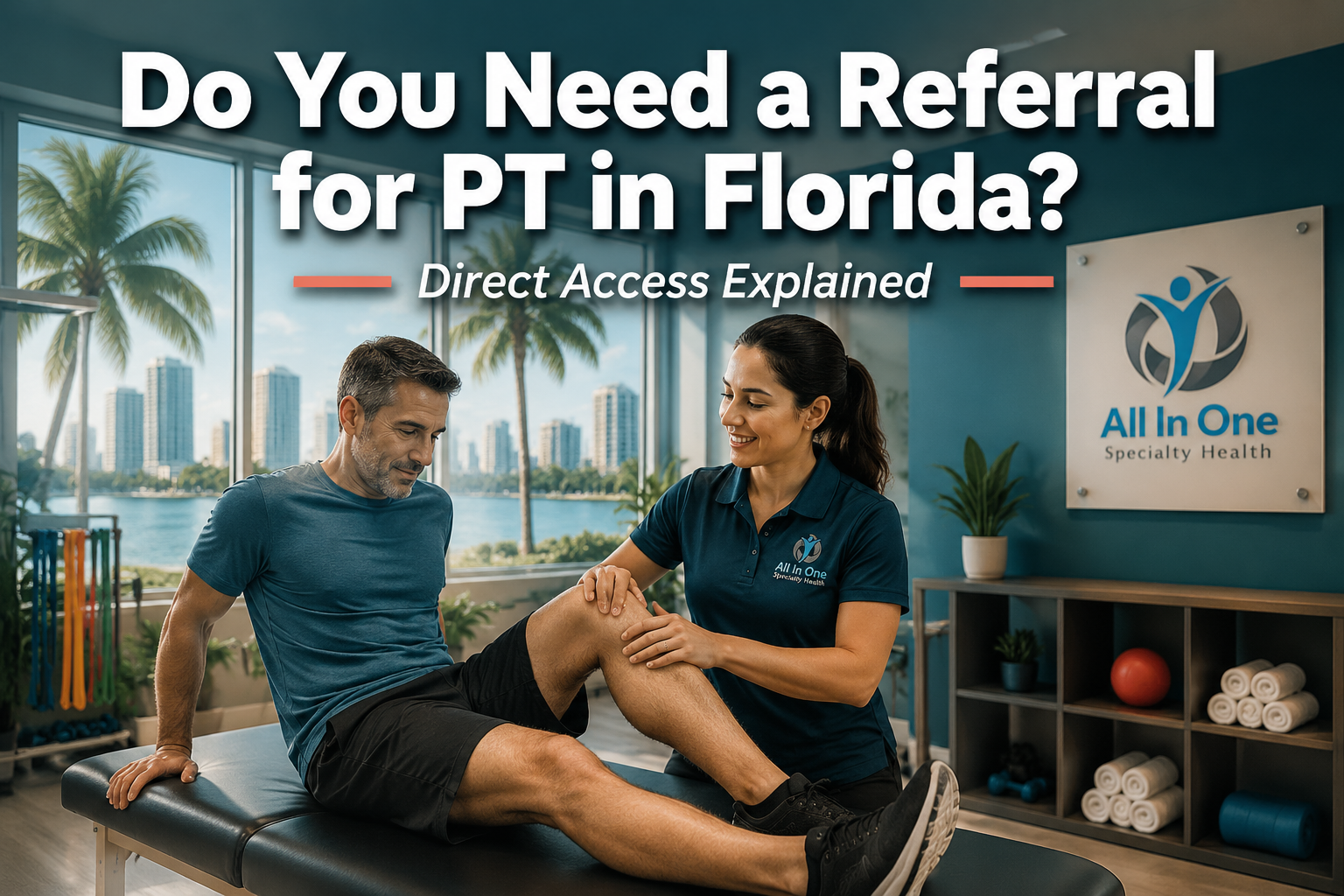
Do You Need a Referral for PT in Florida? Direct Access Guide
No, you do not need a doctor's referral to start physical therapy in Florida. State law allows licensed physical therapists to evaluate and treat patients directly for up to 30 days without a physician's prescription.
June 2, 2026
Clinically reviewed by Patricia Freire, PT (Florida license PT13065), All In One Specialty Health, Miami Gardens. Medical disclaimer
Last updated: June 3, 2026
Quick Answer
No, you do not need a doctor's referral to start physical therapy in Florida. State law allows licensed physical therapists to evaluate and treat patients directly for up to 30 days without a physician's prescription. After that 30-day window, a referral from a licensed physician, dentist, podiatrist, or ARNP is required to continue care. Your insurance plan, however, may have its own rules, so it's smart to confirm coverage before your first visit.
Key Takeaways
- Florida is a direct access state: you can see a physical therapist without a doctor's referral for the first 30 days of care.
- After 30 days, Florida law requires a referral from a physician, dentist, podiatrist, or advanced practice nurse to continue PT.
- Medicare does not require a referral, but it does require a physician to sign your plan of care within 30 days.
- Most commercial insurance plans in Florida cover direct access PT, but some still require a referral or prior authorization to pay claims.
- Direct access can save time, money, and unnecessary imaging for many common musculoskeletal issues.
- Certain "red flag" symptoms still require a physician first — your PT will screen for them at the evaluation.
- Bilingual, same-week appointments are available at All In One Specialty Health in Miami Gardens, serving Miami Lakes and Hialeah.
How Does Direct Access to Physical Therapy Work in Florida?
Direct access means you can schedule, attend, and pay for physical therapy without first seeing a physician or getting a written prescription. Under Florida Statute 486.021, licensed physical therapists are trained as primary musculoskeletal providers and can perform a full evaluation, build a treatment plan, and begin care on day one.
Here's what happens when you walk in through direct access:
- You book an evaluation directly (no doctor visit required).
- Your physical therapist takes a detailed history and screens for red flags.
- You receive a personalized treatment plan that same visit.
- Treatment begins — usually that day or within the same week.
- If care extends past 30 days, your PT will ask for a referral from your doctor.
This pathway removes a major step that often delays recovery. For a deeper look at the law, see our overview of direct access physical therapy in Florida.
Can I Go Straight to a Physical Therapist Without Seeing a Doctor First?
Yes. In Florida, adults can self-refer to a licensed physical therapist and begin treatment immediately. You do not need to visit urgent care, primary care, or an orthopedist beforehand.
Choose direct access if:
- Your pain or injury is musculoskeletal (joints, muscles, tendons, ligaments).
- You want to avoid waiting weeks for a specialist appointment.
- You're paying cash or your insurance allows direct access.
- You've had a similar issue before and recognize the pattern.
See a doctor first if:
- You have sudden severe pain after major trauma.
- You suspect a fracture, infection, or systemic illness.
- You have unexplained weight loss, fever, or night pain.
Your physical therapist is also trained to recognize when something needs medical workup and will refer you out if needed.
What Are the Limitations of Direct Access PT in Florida?
The biggest limitation is the 30-day rule. After 30 days of treatment without a referral, Florida law requires your PT to obtain one from a physician, dentist, podiatrist, chiropractor, or ARNP before care can continue.
Other limitations include:
- Insurance rules can override state law. Your plan may still require a referral or prior authorization to reimburse claims, even though state law doesn't.
- Imaging and prescriptions are outside a PT's scope. If you need an MRI, X-ray, or medication, your PT will coordinate with a physician.
- Some conditions sit outside PT scope — neurological emergencies, suspected fractures, and certain post-op protocols require physician oversight from the start.
How Much Does Physical Therapy Cost Without a Doctor's Referral?
Cash-pay physical therapy in Miami-Dade typically runs $90 to $175 per session for an initial evaluation and $75 to $150 per follow-up visit, depending on the clinic, length of session, and treatments used. Direct access doesn't add cost — in fact, it often saves money by skipping a separate doctor's copay and an extra waiting period.
For a clearer breakdown by service type, our team explains post-surgical PT costs in Miami Gardens.
A quick comparison:
| Pathway | Typical Out-of-Pocket | Time to Start |
|---|---|---|
| Direct access (cash) | $90–$175/visit | Same week |
| Direct access (insurance) | Copay only (often $20–$60) | Same week |
| Referral pathway | Doctor visit + PT copay | 2–6 weeks |
Which Insurance Plans Cover PT Without a Referral in Florida?
Most major commercial insurers in Florida cover direct access PT, but the details vary by plan. Always confirm with your insurer or ask the clinic to run a benefits check.
Generally direct-access friendly:
- Most Florida Blue PPO plans
- Aetna PPO
- Cigna PPO
- UnitedHealthcare PPO
- Most self-funded employer plans
Often require a referral or authorization:
- HMO plans (almost always need a PCP referral)
- Some Medicaid managed-care plans (our clinic does not accept Medicaid)
- Workers' comp claims (require adjuster authorization)
- Auto/PIP cases (require crash documentation)
For a fuller view, our guide to physical therapy insurance in Florida walks through plan types and what to ask. You can also read does insurance cover physical therapy in Florida for specifics.
Do Medicare and TRICARE Require a Referral for PT in Florida?
Medicare does not require a referral to start physical therapy, but it does require a physician (or NP/PA) to sign the PT's plan of care within 30 days for visits to be covered. Your physical therapist usually handles this paperwork — you don't need to schedule a separate doctor's visit just for the signature.
TRICARE rules depend on the plan:
- TRICARE Prime usually requires a referral from your primary care manager.
- TRICARE Select typically allows direct access without a referral, though prior authorization may apply for extended care.
Seniors on Medicare can review our Medicare physical therapy in Miami Gardens page for coverage details and visit limits.
Who Shouldn't Use Direct Access to Physical Therapy?
Direct access is safe for most adults with musculoskeletal pain, but it's not the right first step for everyone. See a physician first if you have any of these red flags:
- Sudden, severe pain after a major fall, crash, or trauma
- Numbness or weakness in the legs combined with loss of bladder or bowel control
- Unexplained weight loss with new back or joint pain
- Fever, chills, or night sweats with musculoskeletal pain
- Chest pain or shortness of breath
- History of cancer with new bone pain
- Suspected fracture (deformity, inability to bear weight)
Children under 18 also generally need a parent's consent and, in some cases, a pediatrician's involvement. If you're recovering from a recent surgery, your surgeon's protocol typically dictates when PT starts — see our guide on when to start PT after surgery.
What Conditions Are Best Treated Through Direct Access PT?
Direct access works especially well for common musculoskeletal problems where early intervention shortens recovery and reduces costs.
Excellent candidates for direct access:
- Low back pain and sciatica
- Neck pain and tension headaches
- Shoulder impingement and rotator cuff strains
- Tennis and golfer's elbow
- Knee pain, runner's knee, IT band issues
- Hip pain and bursitis
- Plantar fasciitis and ankle sprains
- Chronic mobility loss and arthritis flare-ups
- Tendonitis and overuse injuries
For our full list, see conditions treated with physical therapy.
"Patients who start PT within two weeks of pain onset often need fewer total visits and less imaging than those who wait." — a pattern consistently reported in physical therapy outcomes research.
How Long Can I Get Treatment Without a Physician Referral?
Florida law allows up to 30 days of direct-access physical therapy before a referral is required. The clock starts on your first treatment day, not your evaluation date in every case — your clinic will track it for you.
If you need care beyond 30 days, your PT will:
- Contact your primary care doctor (or any qualifying provider) to request a signed referral.
- Continue treatment seamlessly once the referral is on file.
- Update your plan of care based on your progress.
Most patients with simple injuries finish in fewer than 30 days. For more complex cases like post-surgical recovery or chronic pain, a referral simply continues the care you've already started — there's no break in treatment when the paperwork is in place.
What Are Common Mistakes People Make With Direct Access PT?
A few avoidable missteps slow people down or cost them money unnecessarily.
- Skipping the insurance benefits check. Even in a direct-access state, your plan may require pre-authorization to pay claims.
- Waiting too long to start. Pain that's lingered for months often takes longer to resolve than pain caught early.
- Self-diagnosing online. A 15-minute evaluation by a licensed PT is far more accurate than a symptom search.
- Choosing a clinic based only on location. Credentials, specialty, and communication matter more than a few extra minutes of driving.
- Stopping treatment when pain decreases but function hasn't returned. Pain often improves before strength and stability do — finish your plan.
- Missing the 30-day window for a referral. If you'll need extended care, get the referral in motion early.
How Do I Choose a Good Physical Therapist for Direct Access?
Pick a clinic with licensed PTs, strong communication, and experience treating your specific issue. Direct access puts more weight on the therapist's clinical judgment, so credentials and reputation matter.
What to look for:
- DPT or PT license in good standing with the Florida Board of Physical Therapy
- Specialty training relevant to your condition (orthopedic, sports, neuro, vestibular, pelvic floor)
- One-on-one time with the therapist, not handed off to aides
- Clear communication about goals, timeline, and home program
- Bilingual care if English isn't your first language
- Same-week availability so you don't lose momentum
Our guide on how to choose a physical therapist in Miami Gardens walks through the full checklist. You can also review physical therapist credentials to understand what the letters after a name actually mean.
What Documentation Do I Need for Direct Access PT?
Bring the same things you'd take to any new healthcare appointment, plus anything that helps your therapist understand your history.
Bring to your first visit:
- Photo ID
- Insurance card (and a secondary card if applicable)
- A list of current medications and supplements
- Any recent imaging reports (MRI, X-ray, ultrasound) or surgical notes
- A short written history of your symptoms — when they started, what makes them better or worse
- Comfortable clothing you can move in
For a step-by-step walkthrough, see how to prepare for your first PT appointment.
Are There Any Risks to Going to PT Without a Doctor's Referral?
The main risk is missing a non-musculoskeletal cause of your symptoms — but licensed physical therapists are trained specifically to screen for these. During your evaluation, your PT will check for red flags that suggest something beyond their scope and refer you out if needed.
Other small risks:
- Insurance denial if your plan required a referral you didn't get
- Delayed diagnosis of a non-PT condition if you skip a needed medical workup
- Wasted visits if the wrong condition is being treated
The data on direct access has been reassuring: studies of military, hospital, and outpatient settings have shown comparable or better outcomes with direct access compared to physician-referred PT, with fewer visits and lower overall costs. The safety record is strong when patients use licensed providers.
Pros and Cons of Direct Access PT
Pros:
- Faster start to treatment (often same week)
- Fewer appointments and lower total cost
- Less imaging and fewer prescriptions
- Earlier pain relief and return to activity
- Direct communication with your treating clinician
Cons:
- 30-day cap before a referral is required
- Some insurance plans still require authorization
- Not appropriate for medical emergencies or red flags
- Patient must self-identify the right kind of provider
Conclusion: Your Next Step
Florida's direct access law removes one of the biggest friction points in healthcare: you can start physical therapy when you need it, not weeks later when you finally see a specialist. For most common injuries, back and neck pain, post-surgical recovery, and chronic mobility issues, that head start makes a real difference.
If you're in Miami Gardens, Miami Lakes, or Hialeah and unsure whether PT is right for you, the simplest next step is a one-on-one evaluation with a licensed physical therapist who can listen, assess, and give you a straight answer.
Ready to get started? Call (786) 613-7160 or email pt@allinonecaresolutions.com to schedule a same-week evaluation at All In One Specialty Health. We offer bilingual (English/Spanish) evidence-based physical therapy with 10+ years in the community.
All In One Specialty Health
Miami Gardens, FL
Monday, Wednesday and Friday 8:00 AM–5:00 PM; Tuesday and Thursday 8:00 AM–3:00 PM; closed Saturday and Sunday
This article is general education and not a substitute for individual medical advice. Insurance coverage varies by plan; please confirm benefits directly with your insurer.
Frequently Asked Questions
Is Florida a direct access state for physical therapy?
Yes. Florida allows licensed physical therapists to evaluate and treat patients without a physician's referral for up to 30 days.
Do I need a referral for physical therapy in Florida if I have Medicare?
No referral is required to start, but Medicare requires a physician to sign your plan of care within 30 days for visits to be covered.
Can I use my HMO insurance for direct access PT?
Usually not. Most HMO plans still require a primary care referral, even though Florida law doesn't.
How quickly can I be seen for direct access PT in Miami Gardens?
Many clinics, including All In One Specialty Health, offer same-week evaluations. Call ahead to confirm openings.
Does direct access cost more than going through a referral?
No. Direct access often costs less because you skip a separate doctor's visit and copay.
What if I need PT longer than 30 days?
Your physical therapist will request a referral from your physician, dentist, podiatrist, ARNP, or chiropractor so treatment continues without interruption.
Can a physical therapist order an MRI in Florida?
No. Physical therapists cannot order imaging or prescribe medication. If imaging is needed, your PT will coordinate with a physician.
Is direct access safe?
Yes, when you see a licensed PT. Research has shown comparable or better outcomes versus physician-referred care, with strong safety profiles.
Do car accident (PIP) cases allow direct access?
PIP claims have their own documentation and 14-day rules. A physician's involvement is usually needed within the first 14 days.
Can children use direct access PT?
Minors require parental consent, and pediatric cases often involve a physician early in care.
Do I need a referral for sports injury PT?
Not in Florida — but check your insurance plan. See our guide on sports injury PT evaluation for what to expect.
What if my PT thinks I need a doctor instead?
Licensed PTs are trained to screen for red flags. If your symptoms suggest something outside their scope, they'll refer you to the right provider.
More from the blog
Related reading

Questions about this recovery topic?
Our bilingual physical therapy team in Miami Gardens can help you understand next steps after reading this guide.
This website is for informational purposes only and is not a medical emergency service. If you are in immediate danger or experiencing a mental health crisis, call 911 or 988.
Call for assistance