Blog
Plantar Fasciitis Treatment: Lasting Relief Beyond Stretching
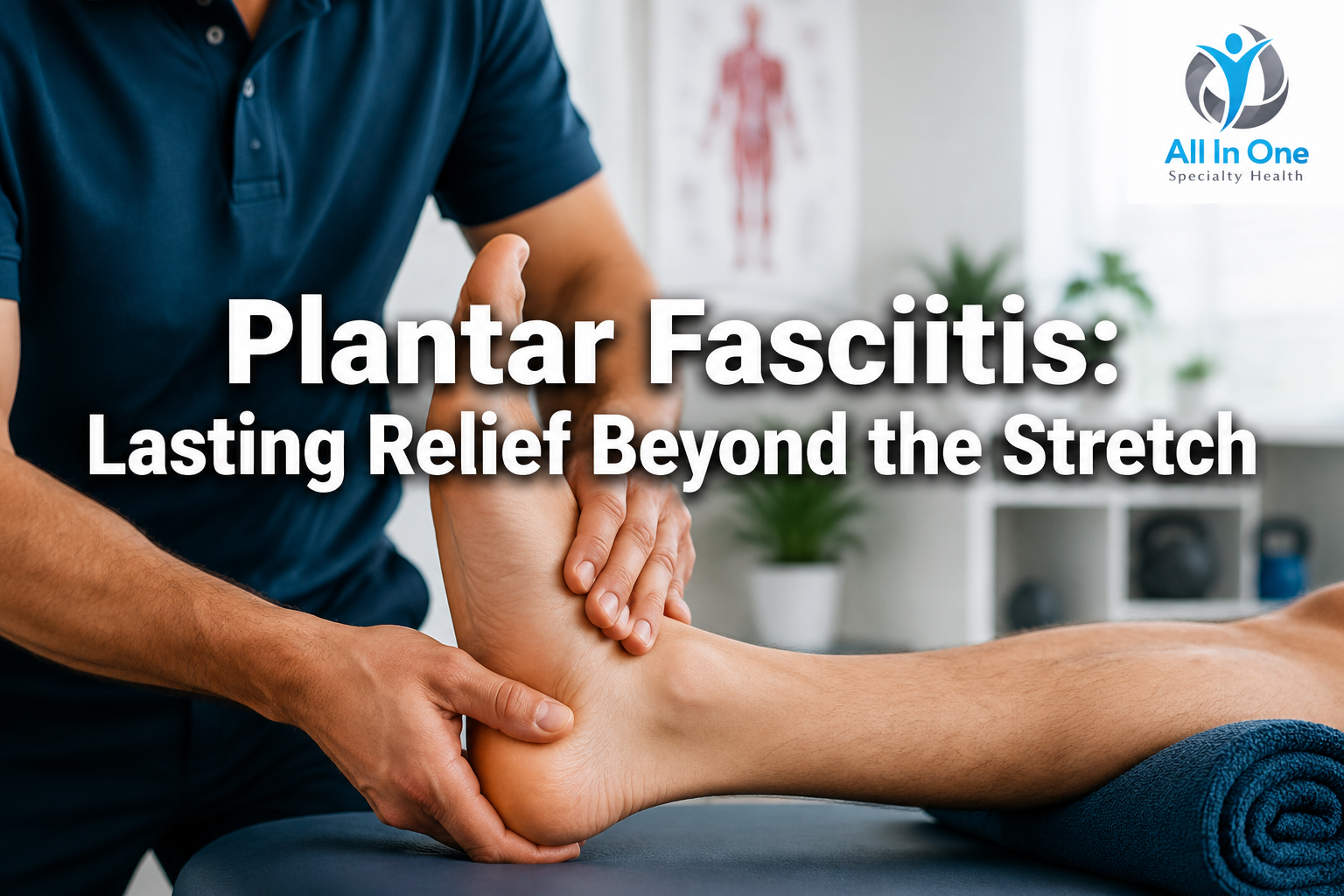
Plantar fasciitis treatment works best when it goes deeper than the standard calf stretch and frozen water bottle routine.
June 2, 2026
Clinically reviewed by Patricia Freire, PT (Florida license PT13065), All In One Specialty Health, Miami Gardens. Medical disclaimer
Last updated: June 3, 2026
Quick Answer
Plantar fasciitis treatment works best when it goes deeper than the standard calf stretch and frozen water bottle routine. Lasting relief comes from a combination of manual therapy, targeted strengthening, gait correction, footwear changes, and load management — not from one exercise alone. At All In One Specialty Health in Miami Gardens, licensed physical therapists build a personalized treatment plan that addresses the root cause, not just the morning heel pain.
Key Takeaways
- Plantar fasciitis is an overload injury of the plantar fascia, not just inflammation — that's why pure rest rarely cures it.
- Most cases improve within 6 to 12 months, but evidence-based physical therapy can shorten that timeline significantly.
- Stretching alone is not enough. Strengthening the foot, calf, and hip muscles is what produces lasting change.
- Shoes and orthotics matter, but they support the fix — they don't replace it.
- Cost varies by insurance; most plans, Medicare, and PIP after an auto accident cover medically necessary PT.
- Florida is a direct-access state, so you can usually start physical therapy without a doctor's referral.
- The biggest mistakes: stopping treatment too soon, ignoring hip and core weakness, and wearing unsupportive shoes at home.
- Same-week appointments are available at our Miami Gardens clinic, with bilingual care for Miami Lakes and Hialeah patients.
What Exactly Is Plantar Fasciitis and Why Does It Hurt So Much
Plantar fasciitis is irritation and micro-damage to the plantar fascia, the thick band of tissue running from your heel to your toes. It hurts so much because that tissue absorbs every step you take, and once it becomes overloaded, even standing up from a chair sends a sharp signal through the heel.
The classic sign is stabbing heel pain with your first steps in the morning, or after sitting for a while. The fascia stiffens at rest, then gets pulled abruptly when you stand. That tug on already-damaged tissue is what creates the sharp, deep ache.
Researchers now describe it more as plantar fasciosis — a degenerative condition — rather than pure inflammation. That distinction matters: it explains why anti-inflammatories alone often disappoint, and why loading the tissue correctly (not just resting it) is what drives healing.
How Long Does Plantar Fasciitis Typically Take to Heal Completely
Most people see meaningful improvement in 3 to 6 months with consistent treatment, and full resolution within 6 to 12 months. With structured physical therapy, that timeline often shortens because the underlying mechanics get corrected, not just the symptoms.
Healing speed depends on:
- How long you've had it. Pain present for under 3 months responds faster than pain you've ignored for a year.
- Your daily load. Standing jobs, running, and heavy body weight slow recovery.
- Your consistency. Skipping home exercises is the number one reason people stall.
- Footwear. Walking barefoot on tile floors (very common in South Florida homes) keeps re-irritating the tissue.
Choose patience over panic: a flare-up at week 4 doesn't mean you're failing. It usually means load needs adjusting.
Can Physical Therapy Actually Fix Plantar Fasciitis or Just Manage Symptoms
Physical therapy can genuinely resolve plantar fasciitis in most cases, not just mask the pain. Evidence-based PT targets the root drivers — tissue overload, weak foot intrinsics, tight calves, poor hip control — and rebuilds the system so the fascia stops getting overworked.
A real PT plan goes beyond the stretch. Expect:
- Manual therapy to mobilize the fascia, calf, and ankle joint.
- Progressive loading with heel raises and isometrics (the most-studied effective intervention).
- Strengthening of the foot intrinsics, glutes, and core.
- Gait analysis to spot the walking or running patterns that triggered the problem.
- Neuromuscular re-education to retrain how your foot loads with each step.
- Education on shoes, activity pacing, and flare-up management.
For deeper detail on what an evaluation looks like, see our guide to plantar fasciitis physical therapy and specific exercises that work.
"Stretching feels good in the moment, but strength is what holds the gains. That's the piece most people skip."
Best Shoes and Orthotics for Plantar Fasciitis Relief
The best shoes for plantar fasciitis have firm arch support, a cushioned heel, a slightly stiff sole, and a small heel-to-toe drop (about 8–12 mm during a flare). Avoid completely flat shoes, worn-out sneakers, and walking barefoot on hard floors.
What tends to help:
- Supportive walking or running shoes (replace every 400–500 miles).
- Cushioned recovery sandals for around the house — especially important on tile.
- Over-the-counter orthotics with a contoured arch (often enough for most people).
- Custom orthotics if you have a high arch, flat foot, or asymmetry that off-the-shelf inserts can't address.
What tends to hurt:
- Flip-flops, flat sandals, and worn-down house slippers.
- Minimalist or "barefoot" shoes during an active flare.
- High heels worn all day.
Orthotics are a tool, not a cure. They reduce strain while your tissue heals and your strength catches up.
Are There Home Remedies That Really Work for Plantar Fasciitis Pain
Yes — several home strategies genuinely help when used consistently alongside professional care. The most effective combination is daily targeted exercise, ice for flare-ups, supportive footwear indoors, and load management.
A practical home routine:
- Morning prep: Before stepping out of bed, do 20 seated toe curls and 20 ankle circles to wake up the fascia gently.
- Calf strengthening: Slow heel raises on a step, 3 sets of 12, every other day. This is the most evidence-supported exercise.
- Soft tissue work: Roll a frozen water bottle under the arch for 10 minutes after long days.
- Towel scrunches: Pick up a towel with your toes — rebuilds the small foot muscles.
- Indoor support: Wear supportive sandals at home, not bare feet on tile.
Skip the gimmicks. Most "miracle" devices sold online are calf stretchers in disguise. The boring basics, done daily, win.
Is Plantar Fasciitis More Common in Athletes or Older People
Plantar fasciitis is common in both groups, but for different reasons. Runners and active 30–50-year-olds get it from training overload, while adults 45–65 often develop it from a mix of weight gain, reduced tissue elasticity, and long hours standing.
Athlete profile: Sudden mileage increases, hill work, worn shoes, weak hips, tight calves. The fix usually involves load management, strength work, and gait retraining. Active patients can review our sports rehab options near Miami Lakes.
Older adult profile: Reduced fat pad cushioning under the heel, stiffer calves, and conditions like arthritis or diabetes. The fix leans more on footwear, gentle strengthening, and addressing whole-body mechanics. Our orthopedic PT for Miami Lakes and Hialeah is built for this population.
Workers on their feet all day — teachers, nurses, warehouse staff, retail — are also at high risk.
What Are the Biggest Mistakes People Make When Treating Plantar Fasciitis
The biggest mistake is treating only the foot and ignoring the chain above it. Hip weakness, poor ankle mobility, and weak core control all push extra load onto the plantar fascia. Heel pain is often the messenger, not the source.
Common mistakes we see:
- Stretching only, never strengthening. Pain improves briefly, then returns.
- Quitting too soon. People stop at week 4 when pain drops 50%, before the tissue is truly remodeled.
- Walking barefoot at home. Tile and hardwood are unforgiving.
- Cortisone shots as a first move. They can help short-term but may weaken the fascia and fat pad with repeat use.
- Ignoring body weight. Even 5–10 lbs makes a measurable difference.
- Pushing through high-impact workouts. Swap running for cycling or pool work during a flare.
Can Losing Weight Help Reduce Plantar Fasciitis Symptoms
Yes. Weight loss is one of the most reliable ways to reduce plantar fasciitis pain, because every pound off your frame is roughly 3–5 pounds less force through the heel with each step. Even modest losses of 5–10% of body weight often produce noticeable relief.
This isn't about appearance — it's about mechanical load. Combine gradual weight management with low-impact cardio (cycling, swimming, elliptical) so you can stay active without re-irritating the fascia. A physical therapist can help design movement that protects your foot while you build other fitness habits.
Night Splints vs Compression Socks — Which Works Better
Night splints generally produce more direct improvement for morning heel pain because they hold the fascia in a lengthened position overnight, reducing that brutal first-step shock. Compression socks help with swelling and circulation but don't address tissue length the same way.
| Feature | Night Splints | Compression Socks |
|---|---|---|
| Best for | Sharp morning heel pain | General foot fatigue, mild discomfort |
| How it works | Holds ankle at neutral, prevents fascia from shortening overnight | Improves blood flow, reduces swelling |
| Comfort | Bulky, takes adjustment | Easy, comfortable |
| Evidence strength | Moderate to good | Limited for plantar fasciitis specifically |
| Best choice when | First steps are the worst part of your day | You stand all day and feet ache by evening |
Many patients benefit from both — splints at night, compression during work hours. Try splints for at least 2–3 weeks before judging results.
How Much Does Professional Treatment for Plantar Fasciitis Cost
Costs vary widely. With insurance, most patients pay a copay of $20–$60 per visit. Without insurance, self-pay rates in Miami-Dade typically range from $90–$175 per session, with discounts often available for prepaid packages. Medicare covers physical therapy when medically necessary, with standard Part B coinsurance applying.
What affects cost:
- Insurance type: Commercial, Medicare, PIP after auto accidents, or workers' comp.
- Referral need: Florida allows direct access, so a referral is often unnecessary.
- Number of visits: Most plantar fasciitis cases need 6–12 sessions.
- Add-on services: Custom orthotics or imaging are billed separately.
For a clear breakdown of what to expect locally, see our physical therapy cost guide for Miami Gardens and how insurance works in Florida.
When Should I See a Doctor About My Plantar Fasciitis
See a healthcare provider when heel pain lasts longer than 2–3 weeks despite rest and basic home care, when it disrupts sleep or your job, or when pain comes with numbness, tingling, swelling, or a recent injury. In Florida, you can usually start with a physical therapist directly — no doctor referral required.
Red flags that mean go now:
- Sudden severe pain with a "pop" sensation (possible fascia rupture).
- Numbness or burning in the foot (possible nerve involvement).
- Visible swelling, redness, or warmth (possible infection or stress fracture).
- Pain that's worse at rest than with activity (uncommon for plantar fasciitis — needs imaging).
Are There Alternative Treatments Like Acupuncture That Might Help
Some alternative treatments show modest evidence for plantar fasciitis, but none replace structured rehab. Acupuncture, dry needling, extracorporeal shockwave therapy (ESWT), and platelet-rich plasma (PRP) all have research supporting use in stubborn cases — usually when standard PT alone hasn't fully resolved symptoms after 3–6 months.
A reasonable sequence:
- Start with evidence-based physical therapy and footwear changes.
- If progress stalls at month 3, add modalities like dry needling or shockwave.
- Reserve injections (cortisone, PRP) for cases not responding to conservative care.
- Surgery is genuinely a last resort — fewer than 5% of patients need it.
Why Choose All In One Specialty Health for Plantar Fasciitis Treatment
Local patients across Miami Gardens, Miami Lakes, and Hialeah choose All In One Specialty Health because of our personalized, bilingual, evidence-based approach. With 10+ years in the community, our licensed physical therapists build plans around your daily life — your job, your floors at home, your activity level — not a generic protocol.
What you can expect:
- A thorough evaluation of foot, ankle, hip, and gait.
- A personalized treatment plan that goes deeper than stretching.
- Bilingual care in English and Spanish.
- Same-week appointments when available.
- Help navigating insurance, Medicare, PIP, and workers' comp.
This article is general education, not individual medical advice. For a plan specific to your foot, schedule an evaluation.
FAQ
How quickly will I feel relief from physical therapy?
Most patients notice some improvement within 2–4 weeks, with meaningful change by week 6–8. Full resolution typically takes 3–6 months of consistent care.
Do I need a referral to start PT in Florida?
Usually no. Florida's direct access law allows you to see a physical therapist without a physician referral for an initial evaluation and treatment period.
Does Medicare cover plantar fasciitis treatment?
Yes, Medicare Part B covers medically necessary physical therapy. Standard 20% coinsurance applies after the deductible.
Will I need imaging like an X-ray or MRI?
Most plantar fasciitis is diagnosed by clinical exam. Imaging is reserved for cases that don't respond to treatment or when a fracture or other condition is suspected.
Can I keep running or working out?
Often yes, with modifications. Swapping high-impact work for cycling or pool training during flares usually keeps fitness up without worsening pain.
Are cortisone shots a good idea?
They can offer short-term relief but don't fix the cause and may weaken tissue with repeated use. Most guidelines recommend trying conservative care first.
Do you offer treatment in Spanish?
Yes. All In One Specialty Health provides bilingual care across all services.
What if I had foot surgery already?
We provide post-surgical PT for ankle and foot procedures tailored to your surgeon's protocol.
Conclusion: Your Next Step Toward Real Relief
Plantar fasciitis doesn't have to define your mornings or limit your weekends. The path to lasting relief goes beyond the stretch — it includes targeted strengthening, smart footwear, gait correction, and a plan built around your real life. Most patients who commit to evidence-based physical therapy recover fully and stay that way.
Ready to take the next step?
- Call (786) 613-7160
- Email pt@allinonecaresolutions.com
- Visit our Miami Gardens clinic — serving Miami Lakes, Hialeah, and all of Miami-Dade County
- Schedule your evaluation online
Same-week appointments are often available. Bilingual care, personalized plans, and a team that listens — that's what whole-person rehabilitation looks like at All In One Specialty Health.
More from the blog
Related reading

Questions about this recovery topic?
Our bilingual physical therapy team in Miami Gardens can help you understand next steps after reading this guide.
This website is for informational purposes only and is not a medical emergency service. If you are in immediate danger or experiencing a mental health crisis, call 911 or 988.
Call for assistance