Blog
Physical Therapy in Miami Lakes: Your First Visit Guide
Your first physical therapy visit in Miami Lakes usually lasts 45 to 75 minutes and includes a detailed health history, a hands-on movement evaluation, and the start of your personalized treatment plan.
June 2, 2026
Clinically reviewed by Patricia Freire, PT (Florida license PT13065), All In One Specialty Health, Miami Gardens. Medical disclaimer
Last updated: June 3, 2026
Quick Answer
Your first physical therapy visit in Miami Lakes usually lasts 45 to 75 minutes and includes a detailed health history, a hands-on movement evaluation, and the start of your personalized treatment plan. At All In One Specialty Health, you don't need a doctor's referral to begin in Florida thanks to direct access, and our bilingual team will guide you through insurance, costs, and next steps in English or Spanish.
Key Takeaways
- A first visit typically runs 45–75 minutes; follow-ups are usually 30–60 minutes.
- Florida allows direct access, so most adults can start physical therapy without a referral.
- Wear loose, comfortable clothing and athletic shoes you can move freely in.
- Most major insurance plans, Medicare, PIP (auto), and workers' comp are commonly accepted at local clinics.
- PT helps with back pain, post-surgical recovery, sports injuries, arthritis, balance issues, and more.
- Treatment shouldn't be sharply painful; mild soreness can be normal as you rebuild strength.
- Many patients notice small improvements within 2–4 sessions, though full recovery varies.
- Physical therapy can sometimes help you delay or avoid surgery, depending on the condition.
What happens at your first physical therapy appointment in Miami Lakes?
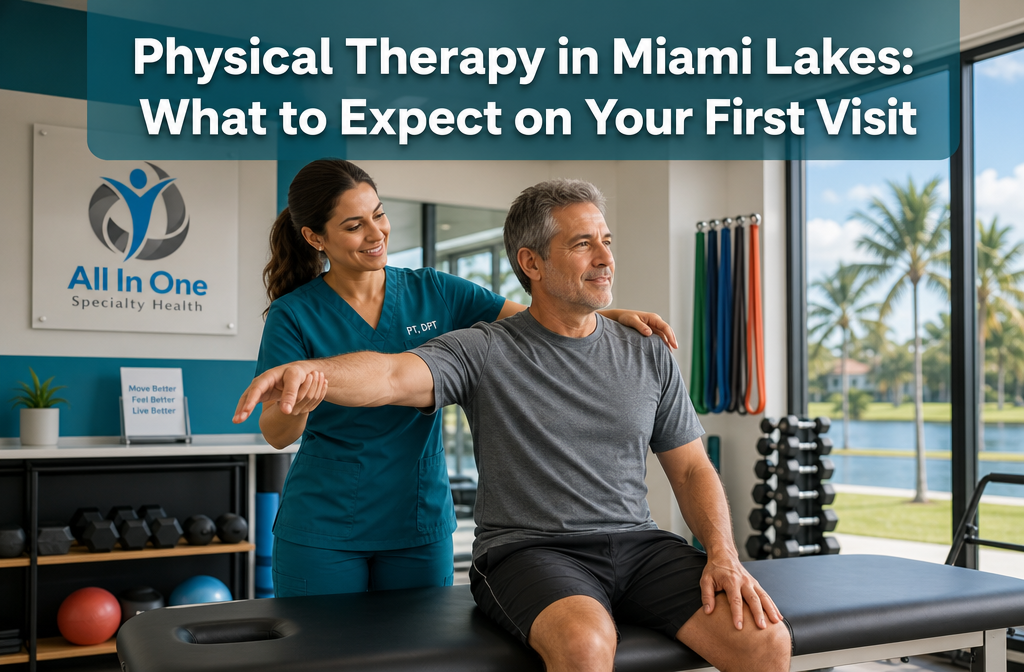
Your first visit is part conversation, part movement assessment, and part hands-on care. A licensed physical therapist will ask about your pain, goals, medical history, and daily activities, then watch how you move, test strength and flexibility, and start treatment the same day when appropriate.
Here's the typical flow:
- Check-in and paperwork (10 minutes). Bring your ID, insurance card, and any imaging reports.
- Interview (10–15 minutes). The therapist asks what hurts, when it started, what makes it worse or better, and what you want to get back to doing.
- Physical evaluation (15–25 minutes). Range of motion, strength, posture, balance, and special orthopedic tests.
- Plan of care discussion (5–10 minutes). Your therapist explains findings in plain language and outlines expected sessions per week and goals.
- First treatment (10–20 minutes). Gentle manual therapy, targeted exercises, or modalities like heat or electrical stimulation.
For a deeper look, see our step-by-step guide to the physical therapy evaluation process.
How much does physical therapy cost in Miami Lakes?
Out-of-pocket physical therapy in the Miami Lakes area typically runs $75–$175 per session for cash-pay patients, while insured patients usually pay only a copay of $20–$60. The exact number depends on your plan's deductible, coinsurance, and whether the clinic is in-network.
A few cost notes specific to South Florida:
- PIP (auto accident): Florida's PIP covers up to $10,000 in medical care, including PT, if you're seen within 14 days of a crash.
- Workers' compensation: Usually covers 100% of approved PT visits with no copay.
- Medicare Part B: Covers 80% of approved PT charges after the deductible.
- Cash-pay packages: Many clinics offer bundle pricing for uninsured patients.
For a detailed breakdown, read our full physical therapy cost guide.
What should you wear to your first PT appointment?
Wear loose, athletic-style clothing you can stretch, bend, and sweat in. Think gym shorts or yoga pants, a t-shirt, and supportive sneakers. Avoid jeans, tight skirts, dress shoes, or anything that restricts the area being treated.
Quick clothing guide by body part:
- Knee, hip, or ankle issues: Shorts work best so the therapist can see the joint.
- Shoulder or neck pain: A tank top or loose t-shirt allows full arm motion.
- Lower back pain: Stretchy pants and a fitted (not baggy) top.
- Post-surgical: Easy-on, easy-off clothing around the surgical site.
More tips here: what to wear to physical therapy.
How long does a typical physical therapy session last?
Most physical therapy sessions last 45 to 60 minutes, with the very first evaluation sometimes stretching to 75 minutes. Follow-up visits are shorter and focus on progressing your exercises and hands-on treatment.
A typical follow-up looks like this:
- 5–10 minutes: warm-up and check-in on symptoms
- 15–25 minutes: therapeutic exercise and neuromuscular re-education
- 10–15 minutes: manual therapy (joint mobilization, soft tissue work)
- 5–10 minutes: modalities (ice, heat, electrical stim) and home program review
Do you need a doctor's referral for PT in Miami Lakes?
In most cases, no. Florida has direct access to physical therapy, meaning a licensed physical therapist can evaluate and treat you for up to 30 days without a physician referral. After 30 days, a referral is required to continue care.
A few exceptions where a referral may still be required:
- Some HMO insurance plans require a referral for coverage.
- Medicare requires a physician sign-off on your plan of care (the PT can still see you first).
- Workers' comp and PIP cases often involve a referring provider.
Learn more about direct access physical therapy in Florida.
What conditions can physical therapy help treat?
Physical therapy treats a wide range of musculoskeletal, neurological, and post-surgical conditions. If pain, stiffness, weakness, or loss of function is limiting your daily life, PT is usually a strong first-line option.
Common conditions treated at our Miami Gardens clinic (serving Miami Lakes and Hialeah):
- Lower back pain, sciatica, herniated and bulging discs
- Neck pain, whiplash, and tension headaches
- Shoulder injuries, rotator cuff tears, frozen shoulder
- Knee pain, meniscus injuries, arthritis
- Hip pain, bursitis, labral tears
- Ankle sprains, plantar fasciitis, Achilles issues
- Post-surgical recovery (ACL, knee replacement, rotator cuff, spine)
- Sports injuries and return-to-play rehab
- Balance problems, dizziness, fall prevention for seniors
- Chronic pain and mobility loss
See the full list of conditions we treat.
Is physical therapy painful or uncomfortable?
Physical therapy shouldn't cause sharp or lasting pain. Mild muscle soreness, like you'd feel after a workout, is normal in the first few sessions as your body adapts. A skilled therapist works with your pain tolerance, not against it.
What's normal vs. what's not:
| Normal | Not Normal |
|---|---|
| Mild soreness 24–48 hours after a session | Sharp, stabbing pain during exercise |
| Temporary stiffness when starting a new exercise | Pain that lasts more than 2 days |
| Mild discomfort during a stretch | Numbness, tingling, or weakness that's new |
| Fatigue in the muscles being trained | Swelling that increases significantly |
If something feels wrong, tell your therapist immediately. Read more about whether physical therapy is painful.
"Good physical therapy challenges you, but it shouldn't hurt you. Communication with your therapist is the difference between progress and setback."
What credentials should a good physical therapist have?
Look for a Doctor of Physical Therapy (DPT) or Master of Physical Therapy (MPT) who is licensed by the Florida Board of Physical Therapy Practice. Additional certifications in orthopedic, sports, vestibular, or manual therapy are strong signs of advanced training.
Credentials to look for:
- DPT or MPT degree from an accredited program
- Active Florida PT license (verify on the FL DOH website)
- OCS (Orthopedic Certified Specialist) or SCS (Sports Certified Specialist)
- Manual therapy certifications (COMT, FAAOMPT)
- Continuing education in your specific condition
- Bilingual ability if Spanish-language care matters to you
More on choosing the right physical therapist.
How many sessions will you likely need?
Most patients attend physical therapy 2–3 times per week for 4–8 weeks, totaling 8–24 sessions. Simple issues like a mild ankle sprain may resolve in 4–6 visits, while post-surgical rehab or chronic conditions can take 12 weeks or longer.
General guidelines by condition:
- Acute strain or sprain: 4–8 sessions
- Lower back pain (non-surgical): 8–12 sessions
- Rotator cuff injury (non-surgical): 10–16 sessions
- Post-ACL surgery: 4–9 months of rehab
- Total knee replacement: 6–12 weeks of formal PT
- Chronic pain or balance issues: Often 12+ sessions plus a home program
Your therapist will reassess every 2–4 weeks and adjust. See our guide on how many physical therapy sessions you may need.
Can physical therapy help you avoid surgery?
For many orthopedic conditions, yes. Research shows that PT is often as effective as surgery for issues like meniscus tears, rotator cuff problems, lumbar disc herniation, and knee arthritis, especially as a first step. Surgery is sometimes unavoidable, but trying PT first is a low-risk option.
PT may help you avoid or delay surgery for:
- Knee osteoarthritis
- Meniscus tears (degenerative)
- Rotator cuff tendinopathy
- Lumbar disc herniation without progressive nerve damage
- Hip impingement (early stages)
- Spinal stenosis
Read more on whether physical therapy can help you avoid surgery.
What's the difference between PT and chiropractic care?
Physical therapy focuses on long-term movement, strength, and functional restoration through exercise, manual therapy, and education. Chiropractic care emphasizes spinal manipulation and short-term pain relief through adjustments. Both can help, but they answer different questions.
Quick comparison:
| Factor | Physical Therapy | Chiropractic |
|---|---|---|
| Primary focus | Movement, strength, function | Spinal alignment, adjustments |
| Treatment length | 45–60 min sessions | 10–20 min visits |
| Tools used | Exercise, manual therapy, modalities | Adjustments, some soft tissue work |
| Best for | Recovery, post-op, chronic conditions | Acute back/neck pain relief |
| Insurance | Widely covered, including Medicare | Coverage varies more |
Full breakdown: physical therapy vs. chiropractic.
Are there age restrictions for physical therapy?
No. Physical therapy is appropriate from young children through seniors in their 90s and beyond. The exercises, hands-on techniques, and goals are simply tailored to age, condition, and personal goals.
A few examples from our patient population:
- Youth athletes recovering from sports injuries
- Working adults with back, neck, or repetitive strain issues
- Postpartum moms regaining core strength
- Post-surgical patients of all ages
- Seniors working on balance, strength, and fall prevention
See our physical therapy for seniors page for age-specific guidance.
What insurance plans cover PT in Miami Lakes?
We accept Aetna (HMO/PPO), Ambetter, AmeriHealth Caritas, AvMed, Cigna (HMO/PPO), Florida Blue (PPO), Humana (PPO), Optum Health, Oscar Health, UnitedHealthcare (HMO/PPO), Medicare Part B, and several Medicare Advantage plans (Aetna HMO, AvMed, CarePlus, Devoted Health, Florida Complete Care, Preferred Care Partners, Solis Health). We do not accept Medicaid. Coverage details, copays, and visit limits vary by plan. See the full list of insurance we accept.
We also accept:
- PIP (Personal Injury Protection) for auto accident patients
- Workers' compensation for work-related injuries
- Medicare Part B with secondary insurance
- Cash-pay with transparent package pricing
Call us at (786) 613-7160 and we'll verify your benefits before your first visit. More on insurance coverage for PT in Florida.
How quickly will you see improvements?
Many patients feel small improvements within 2–4 sessions, especially in pain levels, range of motion, or confidence with movement. Meaningful functional gains usually show up around weeks 3–6, with full recovery taking weeks to months depending on the issue.
Realistic milestones:
- Sessions 1–2: Better understanding of your condition, mild relief
- Sessions 3–6: Noticeable improvement in pain and movement
- Sessions 7–12: Strength returning, daily activities easier
- Sessions 12+: Returning to sports, work, or higher-level activity
Consistency with your home exercise program speeds things up significantly. Skipping it slows progress.
FAQ
Do I need to bring imaging like an MRI to my first visit?
If you have it, yes. MRI, X-ray, or CT reports help your therapist understand your condition, but they're not required to start treatment.
Can I be seen the same week I call?
Often yes. All In One Specialty Health offers same-week appointments for most new patients.
Is bilingual care available?
Yes. Our team provides bilingual physical therapy in English and Spanish.
What if I had a car accident in Florida?
You must be evaluated within 14 days to use your PIP benefits. Don't wait.
Will I get exercises to do at home?
Yes. Your home exercise program is a key part of recovery and is reviewed at every visit.
Can I switch therapists if it's not a good fit?
Absolutely. Communication and trust matter. Ask about scheduling with a different therapist at the clinic.
Does Medicare cover physical therapy?
Yes. Medicare Part B covers 80% of approved PT charges after the deductible, with no hard annual cap as of recent updates.
What if my pain gets worse after a session?
Mild soreness is normal. Sharp, worsening, or radiating pain isn't. Call your therapist for guidance.
Conclusion: Your next step
Starting physical therapy doesn't have to be confusing. A first visit is really just a conversation, an evaluation, and a clear plan tailored to your body and goals. With direct access in Florida, bilingual care, and most insurance plans accepted, there's very little standing between you and feeling better.
Ready to book your first visit?
- Call: (786) 613-7160
- Email: pt@allinonecaresolutions.com
- Visit: All In One Specialty Health, Miami Gardens, FL (serving Miami Lakes, Hialeah, and all of Miami-Dade County)
- Hours: Monday, Wednesday and Friday 8:00 AM–5:00 PM; Tuesday and Thursday 8:00 AM–3:00 PM; closed Saturday and Sunday
With 10+ years of community care, our licensed physical therapists are ready to help you restore mobility, improve function, and get back to the life you want.
This article is general health education and not individual medical advice. For guidance specific to your condition, please consult a licensed physical therapist or physician.
More from the blog
Related reading

Questions about this recovery topic?
Our bilingual physical therapy team in Miami Gardens can help you understand next steps after reading this guide.
This website is for informational purposes only and is not a medical emergency service. If you are in immediate danger or experiencing a mental health crisis, call 911 or 988.
Call for assistance