Blog
Frozen Shoulder Stages & PT Treatment: Miami Gardens Guide
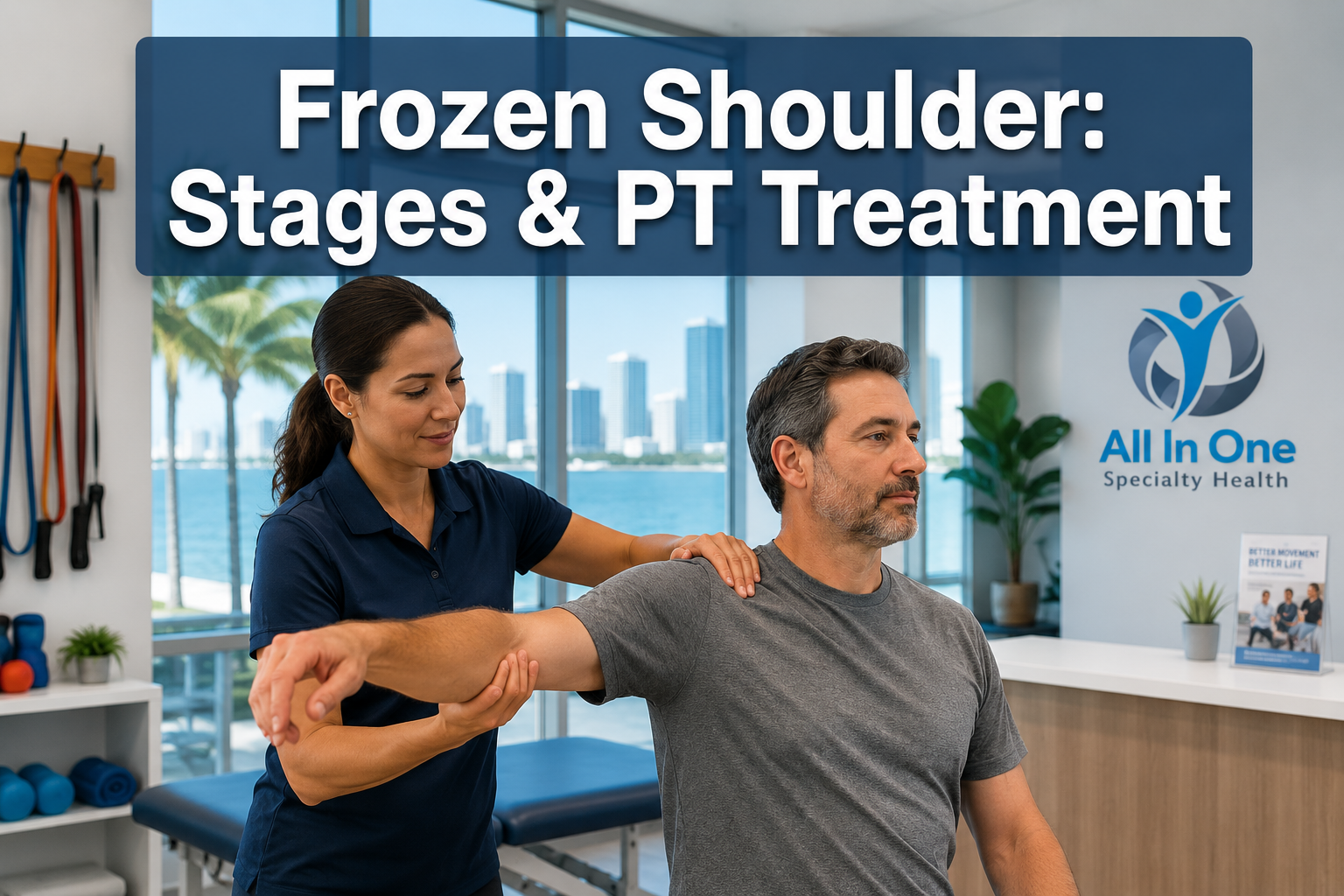
Frozen shoulder, also called adhesive capsulitis, is a condition where the capsule around your shoulder joint thickens and tightens, causing pain and a steady loss of motion.
June 2, 2026
Clinically reviewed by Patricia Freire, PT (Florida license PT13065), All In One Specialty Health, Miami Gardens. Medical disclaimer
Last updated: June 3, 2026
Quick Answer
Frozen shoulder, also called adhesive capsulitis, is a condition where the capsule around your shoulder joint thickens and tightens, causing pain and a steady loss of motion. It moves through three stages — freezing, frozen, and thawing — and typically lasts 12 to 30 months. Most people recover without surgery when guided by evidence-based physical therapy that matches the right exercises to the right stage. At All In One Specialty Health in Miami Gardens, our bilingual team builds personalized treatment plans for patients across Miami Lakes and Hialeah to restore mobility and reduce pain.
Key Takeaways
- Frozen shoulder progresses through three stages: freezing (painful), frozen (stiff), and thawing (recovering).
- The full cycle often lasts 1 to 2.5 years, but physical therapy can shorten the journey and reduce pain.
- Adults over 40, women, and people with diabetes or thyroid issues face higher risk.
- Aggressive stretching during the freezing stage is one of the most common — and most damaging — mistakes.
- Most patients recover without surgery using stage-matched manual therapy and a home program.
- Florida direct access laws let you start physical therapy without a doctor's referral in many cases.
- Cost varies by insurance, but most plans (including Medicare) cover PT for adhesive capsulitis.
- Early evaluation matters: distinguishing frozen shoulder from rotator cuff or impingement changes the plan.
What Exactly Is Frozen Shoulder and How Does It Develop?
Frozen shoulder is the gradual thickening, inflammation, and contraction of the shoulder joint capsule — the connective tissue sleeve that holds the ball of your upper arm bone in its socket. As the capsule tightens, it physically restricts how far your arm can move, no matter how hard you try.
It usually develops in one of two ways:
- Primary (idiopathic): No clear cause. The capsule begins to inflame on its own, often linked to underlying conditions like diabetes or thyroid disease.
- Secondary: Triggered by an injury, surgery, or a period of immobilization (a sling, a fracture, a stroke, or even prolonged shoulder pain that made you stop moving the arm).
The hallmark sign is a loss of both active motion (when you move the arm yourself) and passive motion (when someone else moves it for you). That second part is what separates adhesive capsulitis from most other shoulder problems.
How Long Does Each Stage of Frozen Shoulder Typically Last?
Frozen shoulder follows a predictable three-stage pattern, though the timeline varies from person to person.
| Stage | Common Name | Typical Duration | What You Feel |
|---|---|---|---|
| 1 | Freezing | 6 weeks – 9 months | Sharp pain, especially at night; motion starts to decrease |
| 2 | Frozen | 4 – 12 months | Pain often eases, but stiffness peaks; daily tasks become difficult |
| 3 | Thawing | 6 months – 2 years | Motion slowly returns; strength rebuilds |
The total course commonly lasts 12 to 30 months. The good news: skilled physical therapy can ease pain in the freezing stage, prevent further loss in the frozen stage, and speed mobility return during thawing. For a deeper look at recovery timing, see our guide on frozen shoulder healing time with PT.
How Do I Know If My Shoulder Pain Is Frozen Shoulder or Something Else?
Frozen shoulder is often confused with rotator cuff tears, shoulder impingement, or arthritis because they share early symptoms. The clearest distinguishing test is passive range of motion: if a therapist or doctor lifts your arm and it still won't move past a certain point, frozen shoulder is likely.
Watch for this combination:
- Deep, aching pain that's worse at night and when reaching
- Trouble fastening a bra, reaching a back pocket, or putting on a jacket
- Loss of external rotation (hand-to-the-side, rotating outward) — often the first motion lost
- Symptoms that have crept on slowly over weeks, without a clear injury
If your pain came on suddenly after lifting or falling, you're more likely dealing with shoulder impingement or a rotator cuff issue. A licensed PT can sort it out in one visit.
What Physical Therapy Exercises Actually Help Frozen Shoulder?
The right exercises depend entirely on which stage you're in. Doing the wrong ones — or doing the right ones too aggressively — can flare pain and slow recovery.
Freezing stage (pain dominant):
- Pendulum swings (gentle, gravity-assisted)
- Pain-free isometric holds
- Heat application before movement
- Sleep positioning with a pillow under the elbow
Frozen stage (stiffness dominant):
- Wall walks (finger ladder)
- Towel stretches behind the back
- Cross-body adduction stretches
- Passive external rotation with a cane or stick
- Manual therapy and joint mobilizations performed by your therapist
Thawing stage (rebuilding):
- Resistance band rows and external rotation
- Scapular strengthening
- Functional reaching tasks (lifting plates to a shelf, washing hair)
- Sport- or work-specific drills
"The single biggest predictor of a good outcome isn't how hard you stretch — it's matching the right intensity to the right stage." — A guiding principle in our orthopedic PT plans.
Can I Completely Recover From Frozen Shoulder Without Surgery?
Yes. Most people fully or nearly fully recover from frozen shoulder without surgery. Conservative care — physical therapy, anti-inflammatory strategies, and sometimes a corticosteroid injection — resolves the majority of cases.
Surgery (manipulation under anesthesia or capsular release) is typically reserved for the small percentage who:
- Have severe motion loss after 9–12 months of dedicated therapy
- Have diabetes-related cases that don't respond to conservative care
- Need faster return for work or caregiving demands
Even after surgery, physical therapy is what determines the final outcome. To explore whether you can avoid surgery with PT, schedule an evaluation early.
How Much Does Frozen Shoulder Treatment Cost With and Without Insurance?
Costs vary widely based on insurance, visit frequency, and how long care continues. Coverage details change by plan, so the numbers below are general estimates — not a quote.
- With commercial insurance: Copays often run $20–$60 per visit after deductible.
- With Medicare: Part B typically covers 80% of approved PT charges; a supplement plan often picks up the rest.
- PIP (auto accident in Florida): If shoulder stiffness developed after a crash, PIP may cover up to $10,000 if you're seen within 14 days.
- Cash pay: Self-pay rates at community clinics commonly range from about $90 to $175 per visit.
For local pricing details, see our physical therapy cost guide for Miami Gardens. Our front desk verifies your benefits before your first visit so there are no surprises.
Am I More Likely to Get Frozen Shoulder If I'm Over 40 or Have Diabetes?
Yes — and the risk is significant. Frozen shoulder most commonly affects adults between 40 and 60 years old, and women are diagnosed more often than men. Diabetes is the single largest medical risk factor: people with diabetes are roughly 2–4 times more likely to develop adhesive capsulitis, and their cases tend to be more stubborn.
Other risk factors include:
- Thyroid disorders (both hyper- and hypothyroidism)
- Recent shoulder injury, surgery, or prolonged immobilization
- Stroke or Parkinson's disease (anything that reduces arm movement)
- Heart disease and certain autoimmune conditions
If you're in a higher-risk group and notice early shoulder stiffness, early evaluation matters. Catching it during the freezing stage gives the best window to control pain before motion locks down.
What Are the Biggest Mistakes People Make When Treating Frozen Shoulder?
The most damaging mistake is aggressive stretching during the freezing stage. The capsule is inflamed and angry — yanking on it makes the inflammation worse and can extend the timeline by months.
Other common mistakes:
- Resting completely. Total immobility deepens stiffness. Gentle pain-free movement is essential even on bad days.
- Quitting therapy when pain eases. Pain fading doesn't mean the capsule is normal. Stopping during the frozen stage leaves lasting limits.
- Relying only on injections. Cortisone can calm pain but doesn't restore motion. Pair it with skilled PT.
- Doing random YouTube routines. Generic stretches don't account for what stage you're in.
- Ignoring the other shoulder. About 20–30% of people develop it in the opposite shoulder within five years.
What Daily Activities Should I Avoid When Dealing With Frozen Shoulder?
Avoid anything that forces the shoulder into pain or pushes hard past your end range. The goal is steady, gentle movement — not heroic effort.
Limit or modify:
- Heavy lifting overhead (groceries onto a high shelf, carry-on luggage into a bin)
- Sleeping on the affected side
- Sudden reaching (catching a falling object, grabbing a seatbelt across your body)
- Repetitive overhead work without breaks
- Aggressive yoga poses or pull-ups during the freezing or frozen stages
Modify, don't eliminate, everyday tasks. Use your other arm to assist, slide objects instead of lifting, and keep frequently used items at waist-to-chest height.
How Does Frozen Shoulder Impact Athletes and Active People Differently?
Active adults often hit frozen shoulder harder emotionally because the gap between what they could do and what they can do is so wide. Physically, the condition isn't worse — but the impact on swimming, tennis, golf, weightlifting, and overhead sports is dramatic.
Key considerations for athletes:
- Expect a longer return-to-sport timeline than typical orthopedic injuries (often 6–18 months).
- Maintain conditioning with lower-body and core work while the shoulder recovers.
- Avoid forcing through pain; this almost always backfires.
- Use sport-specific PT in the thawing stage to rebuild rotational power and end-range control.
Our sports injury rehabilitation team helps weekend warriors and competitive athletes find creative ways to stay fit while the shoulder catches up.
What Alternative Treatments Work Besides Traditional Physical Therapy?
Several complementary approaches can support — but rarely replace — skilled PT. The evidence is strongest for these:
- Corticosteroid injection: Best results when used in the freezing stage combined with PT.
- Hydrodilatation: A radiologist injects saline to gently stretch the capsule. Helpful for stubborn cases.
- Dry needling: Targets trigger points in surrounding muscles that develop from guarding.
- Aquatic therapy: Buoyancy lets you move further with less pain.
- Acupuncture: Some patients report pain relief, especially at night.
- Heat and graded movement: Simple, free, and effective when done consistently.
Manipulation under anesthesia and arthroscopic capsular release remain surgical options for the small percentage who don't respond after a full conservative trial.
How Can I Prevent Frozen Shoulder From Happening Again After Recovery?
Once recovered, your goal shifts to maintaining motion and addressing risk factors. Recurrence in the same shoulder is rare, but the opposite shoulder is at higher risk.
Prevention strategies:
- Keep moving the shoulder daily through full range, especially overhead and behind the back.
- Manage blood sugar tightly if you have diabetes.
- Don't ignore minor shoulder injuries — early care prevents the immobilization that triggers secondary cases.
- After any shoulder surgery or sling time, start PT promptly.
- Build a maintenance routine: 5–10 minutes of mobility work a few times a week.
What Are the Warning Signs That My Frozen Shoulder Is Getting Worse?
Most cases follow the expected stages, but call your therapist or doctor if you notice:
- Sudden, severe pain after a fall or lifting incident (possible rotator cuff tear on top of capsulitis)
- Numbness, tingling, or weakness traveling down the arm
- Fever, redness, or warmth around the joint (rule out infection)
- Pain that's getting dramatically worse rather than slowly improving
- Total inability to move the arm even passively
These aren't typical frozen shoulder symptoms and warrant prompt evaluation.
Frequently Asked Questions
Do I need a referral for physical therapy in Florida?
No, in most cases. Florida's direct access law lets licensed PTs evaluate and treat you without a physician referral, though some insurance plans still require one for coverage.
Is frozen shoulder painful during physical therapy?
Some discomfort is normal, especially with stretching, but treatment should not cause sharp or lasting pain. A good therapist works at the edge of your tolerance, not past it.
How many PT sessions will I need?
Most patients attend 1–2 times per week for 8–16 weeks, with the heaviest care during the frozen and thawing stages. Your home program does most of the work between visits.
Can I drive with frozen shoulder?
Usually yes, but check turning, reaching the seatbelt, and shifting first. If reaching the steering wheel causes sharp pain, wait until early PT settles symptoms.
Will heat or ice help more?
Heat before movement and ice after exercise is the general rule. Heat relaxes guarded muscles; ice calms post-exercise inflammation.
Does frozen shoulder ever go away on its own?
It can, but recovery without therapy is often incomplete — many people are left with permanent stiffness or weakness. PT improves the final outcome.
Can I work out my other muscles during recovery?
Yes, and you should. Lower body, core, and the unaffected arm can train normally. Staying active helps mood and overall recovery.
Is bilingual physical therapy available?
Yes. All In One Specialty Health offers bilingual care in English and Spanish, serving Miami Gardens, Miami Lakes, and Hialeah.
Conclusion: Your Next Step Toward a Working Shoulder
Frozen shoulder is frustrating, but it's treatable — and in nearly every case, surgery isn't necessary. The earlier you start stage-matched physical therapy, the shorter your recovery and the better your final motion. Generic stretches off the internet won't cut it; this condition rewards a personalized treatment plan from licensed physical therapists who understand the difference between freezing, frozen, and thawing.
At All In One Specialty Health, we've spent 10+ years in the community caring for patients across Miami-Dade County with evidence-based, whole-person rehabilitation. Same-week appointments are often available, and our bilingual team will guide you through insurance, Medicare, and direct access questions.
Schedule your evaluation today:
- Call: (786) 613-7160
- Email: pt@allinonecaresolutions.com
- Visit: All In One Specialty Health, Miami Gardens, FL
- Hours: Monday, Wednesday and Friday 8:00 AM–5:00 PM; Tuesday and Thursday 8:00 AM–3:00 PM; closed Saturday and Sunday
This article is general education and not individual medical advice. For a plan specific to your shoulder, please schedule an evaluation with a licensed physical therapist.
More from the blog
Related reading

Questions about this recovery topic?
Our bilingual physical therapy team in Miami Gardens can help you understand next steps after reading this guide.
This website is for informational purposes only and is not a medical emergency service. If you are in immediate danger or experiencing a mental health crisis, call 911 or 988.
Call for assistance