Blog
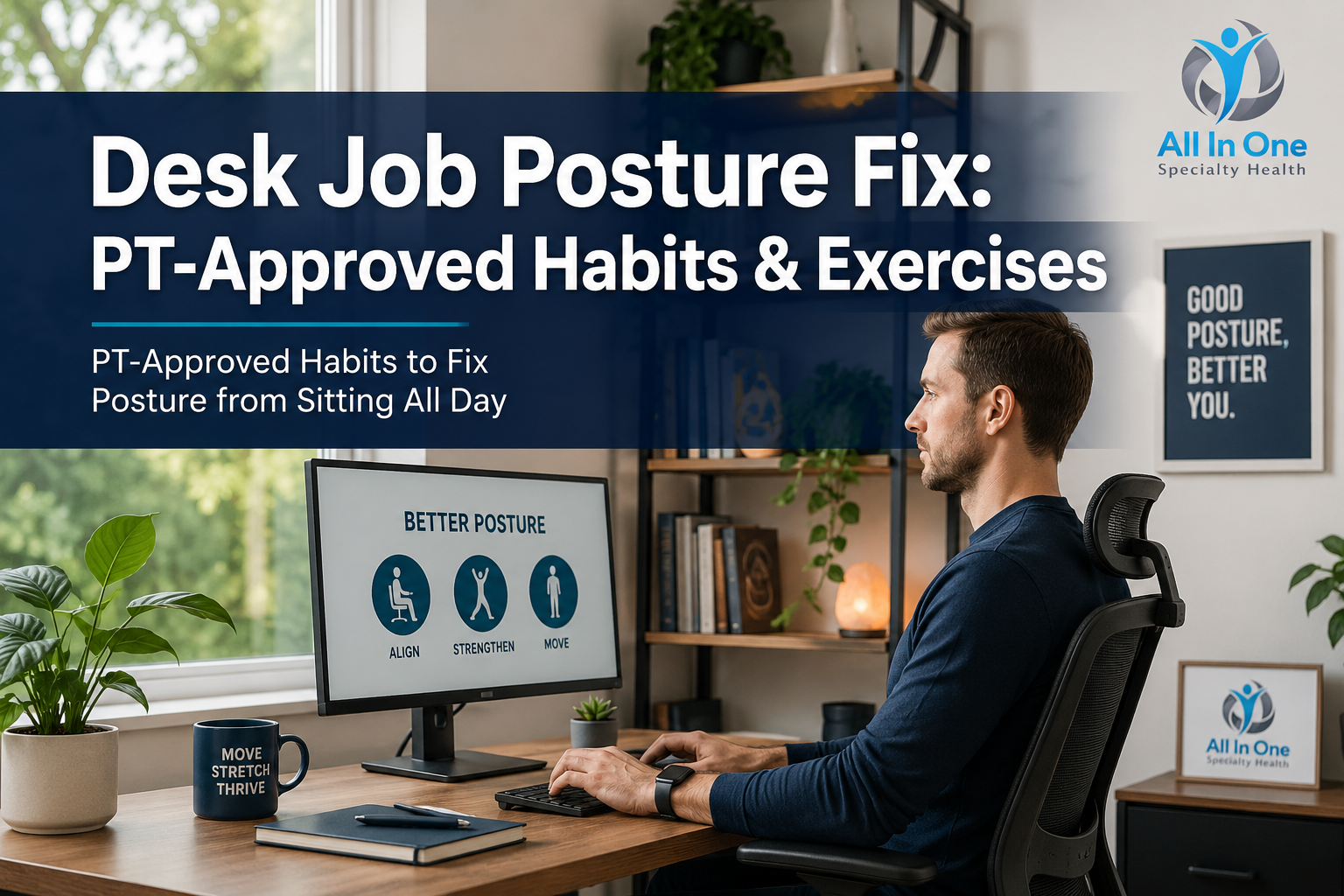
Desk Job Posture Fix: PT-Approved Habits & Exercises
To fix posture from sitting all day, combine three things: an ergonomic setup (monitor at eye level, feet flat, lumbar supported), short movement breaks every 30–45 minutes, and a daily set of PT-approved exercises like…
June 2, 2026
Clinically reviewed by Patricia Freire, PT (Florida license PT13065), All In One Specialty Health, Miami Gardens. Medical disclaimer
Last updated: June 3, 2026
Quick Answer
To fix posture from sitting all day, combine three things: an ergonomic setup (monitor at eye level, feet flat, lumbar supported), short movement breaks every 30–45 minutes, and a daily set of PT-approved exercises like chin tucks, scapular squeezes, doorway chest stretches, and thoracic extensions. Most people feel less neck and back tension within 2–3 weeks of consistent practice. If pain lingers, radiates, or causes headaches or jaw tightness, a licensed physical therapist can build a personalized plan.
A 9-hour workday in a slumped chair compresses the same discs and tightens the same chest muscles that pull your head forward and your shoulders inward — but the fix isn't complicated. It's the boring, repeatable habits most people skip.
Key Takeaways
- "Tech neck," tension headaches, jaw pain, and mid-back stiffness are often the same problem with different addresses: a head that drifts forward for hours a day.
- There is no single "perfect" posture. Public health guidance now favors dynamic sitting — frequent small position changes — over holding one rigid pose.
- Aim for neutral spine, relaxed shoulders, 90–120° joint angles, and a screen at eye level.
- Movement breaks every 30–45 minutes matter as much as your chair.
- Chin tucks and scapular squeezes are the two highest-yield exercises for desk workers.
- Posture braces can help short-term as a reminder, but they don't build the strength needed for lasting change.
- Persistent neck, jaw, or shoulder pain deserves a one-on-one evaluation, not another YouTube routine.
What Are the Main Health Risks of Bad Sitting Posture?
Long-term slouched sitting is linked to neck and upper-back pain, tension headaches, jaw (TMJ) irritation, rounded shoulders, mid-back stiffness, low back strain, and reduced breathing capacity. Most of these are reversible with movement, strengthening, and setup changes.
The biggest culprits are forward head posture and a rounded upper back. When your head drifts even an inch forward of your shoulders, the muscles at the base of your skull and along your upper traps work overtime. Over months and years, that can show up as:
- Daily tension headaches or pain behind the eyes
- Clicking, soreness, or tightness in the jaw
- Shoulder blade "knots" that never fully release
- Numbness or tingling down the arms from compressed nerves
- Low back stiffness that flares after long meetings
The good news: spines are durable. Discomfort from posture is almost always a load problem (too much time in one position) rather than permanent structural damage.
How Do I Know If My Desk Setup Is Ergonomically Correct?
Your desk setup is ergonomically correct when your eyes meet the top third of the screen, your elbows rest near 90°, your hips sit slightly higher than your knees, and your feet are flat on the floor or a footrest. Joint angles should sit between 90° and 120°.
Run this 30-second check right now:
- Eyes: Top of the monitor is at or just below eye level, roughly an arm's length away.
- Ears: Stacked over your shoulders, not in front of them.
- Shoulders: Relaxed and down, not creeping toward your ears.
- Elbows: Bent close to 90°, forearms parallel to the floor.
- Lower back: Supported by the chair's lumbar curve or a small rolled towel.
- Hips: Slightly above the knees.
- Feet: Flat. If they dangle, get a footrest (or a sturdy box).
Common mistake: A laptop on a desk is almost never ergonomic. Either raise it on a stand and add an external keyboard, or connect a separate monitor.
How to Set Up Your Computer Monitor to Reduce Neck Strain
Place the monitor directly in front of you, about an arm's length away, with the top of the screen at or just below eye level. If you use two monitors equally, center them at the seam. If one is primary, that one belongs straight ahead.
A few quick fixes that pay off fast:
- Raise laptops with a stand, books, or a reusable shipping box.
- Avoid placing screens off to one side — chronic head rotation is a major driver of neck pain and headaches.
- Reduce glare with blinds or a matte filter so you don't crane forward to read.
- Bump font size up one level rather than leaning in.
Quick Posture Correction Techniques for People Who Work From Home
The fastest fix is a posture reset every 30–45 minutes: sit tall, tuck the chin slightly, roll shoulders back and down, and take three slow breaths through your nose. That single 20-second habit, repeated, retrains your default position.
Try these "stealth" resets you can do without anyone noticing on a Zoom call:
- Wall reset (before your day starts): Stand with heels, hips, upper back, and head touching a wall for 60 seconds.
- Chair reset: Scoot back so your hips touch the seat back, then sit tall and breathe.
- Chin tuck: Gently draw your chin straight back (think "double chin"), hold 3–5 seconds.
- Shoulder roll: 5 slow shoulder rolls backward, never forward.
For working-from-home setups especially, treat your kitchen counter, hallway, or front door as built-in stretch stations. Pair them with habits you already have (coffee refill, bathroom break, end of a meeting).
Simple Exercises I Can Do at My Desk Without Looking Weird
Yes — most effective desk exercises are nearly invisible. Chin tucks, scapular squeezes, seated thoracic extensions, and ankle pumps can be done in regular clothing while you're on a call.
A 5-minute desk routine you can repeat 2–3 times a day:
- Chin tucks — 10 reps, hold 3 seconds each
- Scapular squeezes — Pinch shoulder blades together, 10 reps
- Seated thoracic extension — Hands behind head, gently arch upper back over chair back, 8 reps (pain-free range only)
- Upper trap stretch — Sit tall, hold the side of the chair with one hand, gently tilt head away, 30 seconds per side
- Seated figure-4 stretch — Ankle on opposite knee, lean slightly forward, 30 seconds per side
For more guided routines you can repeat at home or in the office, see our physical therapy exercises library.
Best Stretches for Office Workers to Prevent Back Pain
The most effective stretches open the front of the body (chest, hip flexors) and mobilize the upper back, because these are the areas that shorten and stiffen from sitting.
Top 4 stretches worth doing daily:
- Doorway chest stretch — Place forearms on a doorframe at shoulder height. Step one foot through and lean gently. Hold 30 seconds.
- Standing hip flexor stretch — Half-kneel (or stand in a lunge), tuck pelvis under, feel the front of the back hip. 30 seconds each side.
- Cat-cow — On all fours or seated, alternate arching and rounding your spine for 8–10 slow cycles.
- Side-of-neck stretch — Sitting tall, hold the chair with one hand, gently tilt ear toward opposite shoulder. 30 seconds per side.
Stretching feels good, but strength is what holds new posture in place. Pair every stretch routine with a few scapular and core exercises.
Physical Therapy Exercises to Realign My Spine After Years of Bad Posture
A PT-led realignment program usually combines mobility work (thoracic extension, chest opening), strengthening (deep neck flexors, mid-back, glutes, core), and neuromuscular re-education so your body adopts the new position automatically.
A typical progression looks like:
- Weeks 1–2: Chin tucks, scapular squeezes, glute bridges, dead bug, doorway stretches.
- Weeks 3–4: Add band pull-aparts, prone Y/T/W raises, wall angels, bird dog.
- Weeks 5–8: Loaded rows, farmer carries, hip hinges, planks — building real strength that supports upright posture under load.
These same patterns also help patients recovering from whiplash and chronic neck pain or rehabbing after spine surgery. If you've tried stretching for months without progress, an evaluation can pinpoint which links in the chain are weak. Our team builds personalized physical therapy plans for exactly this reason — generic videos can't see your movement patterns.
How Long Should I Stand vs Sit During a Typical Work Day?
A practical target is roughly a 20–30 minute sit, 5–10 minute stand, 1–2 minute move cycle throughout the day. Total standing time of 2–4 hours spread across the workday is a reasonable goal for most desk workers.
Key principle: the best posture is your next posture. Public-health guidance has shifted from "sit up straight" toward dynamic sitting — small, frequent changes in position. Standing all day causes its own problems (foot, knee, and low-back fatigue), so think alternation, not replacement.
Are Standing Desks Really Worth the Investment?
Standing desks are worth it if you actually use them dynamically — alternating sit/stand throughout the day. They're not a magic fix on their own.
Choose a standing desk if you:
- Sit more than 6 hours a day
- Have early signs of low back or hip stiffness
- Will commit to alternating positions
Skip it if you:
- Won't change settings (it'll just become an expensive sitting desk)
- Have a foot, ankle, or knee condition that limits prolonged standing
- Can solve the problem with a monitor riser and movement breaks
Pair any standing desk with an anti-fatigue mat and supportive shoes.
Affordable Ergonomic Chair Recommendations Under $300
Under $300, focus on three non-negotiable features rather than brand names: adjustable seat height, adjustable lumbar support, and adjustable armrests. Mesh-back office chairs in this price range from major office-supply retailers typically check these boxes.
What to look for:
| Feature | Why It Matters |
|---|---|
| Adjustable lumbar support | Maintains the natural curve of your low back |
| Seat depth adjustment | Prevents pressure behind the knees |
| Adjustable armrests | Keeps shoulders relaxed, elbows at 90° |
| Tilt/recline lock | Lets you shift positions throughout the day |
| Breathable mesh back | Reduces heat and encourages movement |
Budget hack: A $20 lumbar roll or rolled bath towel placed at your low back will dramatically improve almost any chair you already own.
Signs That My Neck and Shoulder Pain Is From Poor Posture
Postural pain typically feels like a dull ache that worsens through the day, eases with movement, and is concentrated in the upper traps, base of the skull, between the shoulder blades, or jaw.
Common patterns:
- Pain starts mid-morning and peaks by 3–5 p.m.
- Headaches that begin at the base of the skull
- Jaw clenching or TMJ tightness, especially during heavy screen time
- Tingling in the fingers after long typing stretches
- Relief from a walk, shower, or sleep — and return the next workday
Red flags that need a professional evaluation, not more stretching:
- Pain radiating down an arm with weakness or numbness
- Severe night pain
- Pain following an accident or fall
- Headaches with vision changes or dizziness
For ongoing neck symptoms, our clinicians offer neck pain physical therapy tailored to desk workers in Miami Gardens, Miami Lakes, and Hialeah.
Can Sitting Too Much Cause Permanent Damage to My Spine?
For most healthy adults, sitting alone does not cause permanent spinal damage. It causes muscular imbalance, joint stiffness, and disc deconditioning — all of which respond well to movement and strengthening. Long-term sedentary behavior is, however, a recognized risk factor for chronic pain and cardiovascular issues, so the goal is to move more, not panic about your spine.
Do Posture Corrector Braces Actually Work or Are They a Gimmick?
Posture braces work as short-term reminders, not long-term solutions. Wearing one for 20–30 minutes a day can help you feel what "upright" should be, but relying on them all day can weaken the very muscles you're trying to train.
A better approach: use the brace as a feedback tool for 1–2 weeks while you build strength with chin tucks, rows, and scapular work. Then put it away.
Quick Comparison: What Actually Moves the Needle
| Strategy | Effort | Impact | Notes |
|---|---|---|---|
| Movement breaks every 30–45 min | Low | High | Biggest ROI overall |
| Monitor at eye level | Low | High | One-time fix |
| Lumbar support | Low | Medium-High | Towel works fine |
| Daily 5-min desk routine | Low | High | Compounds in weeks |
| Standing desk | Medium ($) | Medium | Only if used dynamically |
| Posture corrector brace | Low | Low-Medium | Reminder tool, not a fix |
| PT-guided program | Medium | Highest | Best for chronic pain |
When to See a Physical Therapist
Self-care works for most early posture issues. Consider a professional evaluation if any of the following apply:
- Pain that has lasted more than 4–6 weeks despite home strategies
- Headaches, jaw pain, or arm numbness tied to sitting
- A history of neck or back injury
- Pain that is interfering with sleep, work, or exercise
A licensed physical therapist will assess your movement, strength, and workstation, then build a plan specific to your body — not a generic checklist. Curious how to choose? Here's our guide to choosing the right physical therapist in Miami Gardens.
FAQ
How long until I see results from posture exercises?
Most people feel reduced tension within 2–3 weeks of daily practice. Visible posture changes take 6–12 weeks because they depend on strength gains, not just stretching.
Can poor posture cause TMJ or jaw pain?
Yes. Forward head posture changes the resting position of the jaw and can contribute to clenching, clicking, and TMJ pain. Addressing neck posture often eases jaw symptoms.
Is it bad to cross my legs at my desk?
Occasional leg crossing is fine. Crossing the same leg for hours, daily, can contribute to hip asymmetry and low back tightness. Alternate or uncross every few minutes.
Do I need a referral for physical therapy in Florida?
Florida allows direct access to physical therapy for evaluation and many treatments, though insurance rules vary. Call your insurer or ask our office to verify coverage.
Does insurance cover PT for posture-related pain?
Many plans cover physical therapy for neck, back, and headache symptoms when medically necessary. Coverage varies — our team will verify benefits before your first visit.
Are kneeling chairs or balance balls better than regular chairs?
They're useful for variety, not as full-time replacements. Use them for 20–30 minutes at a time mixed with a standard chair and standing.
Will sleeping position affect my posture?
Yes. Side or back sleeping with a supportive pillow that keeps the neck aligned is generally best. Stomach sleeping rotates the neck for hours and often worsens morning stiffness.
Can kids and teens get posture problems from screens?
Absolutely. Same principles apply: eye-level screens, movement breaks, and strength work. Habits set in the teen years often follow into adulthood.
Conclusion and Next Steps
Fixing posture from a desk job isn't about willpower or sitting "perfectly." It's about three small commitments: set your workstation up once, move every 30–45 minutes, and spend five minutes a day on a handful of high-yield exercises. Do that for a month and most desk-related neck, back, and shoulder tension fades on its own.
If your symptoms have been hanging around for months — or you're dealing with headaches, jaw pain, or numbness that won't quit — a focused evaluation can save you years of guessing.
Ready to feel better at your desk?
All In One Specialty Health offers bilingual, evidence-based physical therapy with 10+ years serving Miami Gardens, Miami Lakes, and Hialeah. Same-week appointments are often available.
- Call: (786) 613-7160
- Email: pt@allinonecaresolutions.com
- Visit: All In One Specialty Health, Miami Gardens, FL
- Hours: Monday, Wednesday and Friday 8:00 AM–5:00 PM; Tuesday and Thursday 8:00 AM–3:00 PM; closed Saturday and Sunday
This article is general education and not a substitute for individual medical advice. For symptoms that are severe, worsening, or accompanied by red flags (numbness, weakness, severe headache, or trauma), please consult a licensed healthcare provider.
More from the blog
Related reading

Questions about this recovery topic?
Our bilingual physical therapy team in Miami Gardens can help you understand next steps after reading this guide.
This website is for informational purposes only and is not a medical emergency service. If you are in immediate danger or experiencing a mental health crisis, call 911 or 988.
Call for assistance